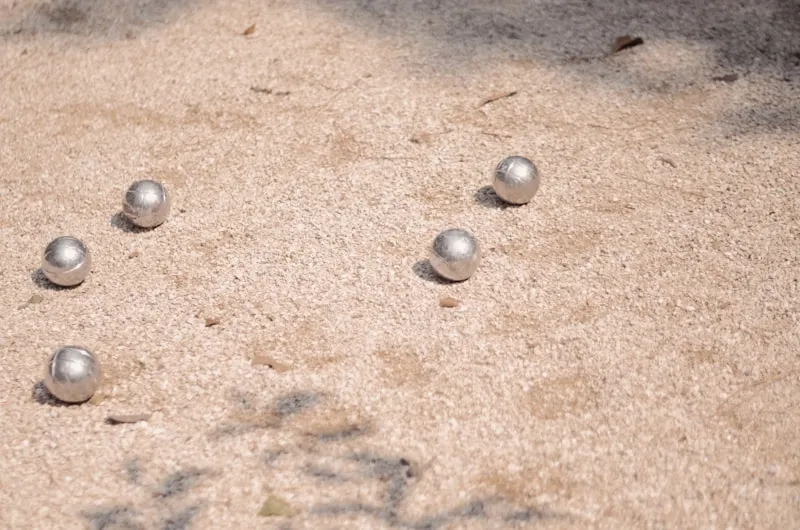
The Cochonnet: Why the Little Pig Rules the Game
The cochonnet — pétanque's small target ball — looks like an afterthought. It's anything but. Understanding how to place the jack strategically transforms your game.
Cochonnet — French for “little pig” — is the humble wooden target ball at the heart of every pétanque game. It’s only 30mm across. It weighs almost nothing. And yet, where you place it can determine the entire shape of a round before a single boule is thrown.
The Rules of the Throw
The player who won the previous round throws the cochonnet for the next. It must land between 6m and 10m from the throwing circle, at least 1m from any boundary line, and be clearly visible.
These constraints leave a surprisingly wide range of strategic choices — and every expert player exploits them deliberately.
The Short Game
Throwing the cochonnet to the minimum distance (6–6.5m) is called playing short. This is a classic tactic when your team has strong pointers but your opponents are better shooters. At 6m, precision pointing is easier; long-range tire shots become less consistent.
The counter to this is easy — your opponents simply throw short too next round. But forcing opponents to adjust their default rhythm has value even when they can compensate.
The Long Game
Throwing to 9–10m suits teams with powerful, accurate shooters. At greater distances, subtle terrain variance matters more, making it harder for opponents to point reliably. Strong tiring teams also benefit because they can deliver the tire with more velocity and certainty than opponents pointing at distance.
The Diagonal Throw
Rather than throwing the cochonnet straight down the terrain’s long axis, some players angle it diagonally — close to one side boundary. This restricts where opponents can safely aim their boules, creates an awkward approach angle for tires, and forces your opponents to point from an uncomfortable stance.
Master players don’t just throw the cochonnet where there’s open space. They throw it where their strengths have the most impact and their opponents’ strengths have the least.
Terrain Exploitation
A good cochonnet placement also takes advantage of terrain features. Behind a subtle dip forces boules to roll unpredictably on approach. On a slight uphill slope, boules leave the dip and run past. On a downslope, they stop short.
Study your local terrain until you know every hollow, ridge, and dry patch. Then use the cochonnet to funnel the game toward the terrain conditions that suit your team.
Protecting the Cochonnet
Once the cochonnet is placed, your first boule should land close enough to protect it — or at least define the space around it. A cochonnet with no friendly boule near it is an open invitation for your opponent to point aggressively in any direction.
Experienced players think of the cochonnet and the first boule as a pair: the jack defines the target, and the first boule begins establishing ownership of it. For the precise techniques to land that first boule exactly where you intend, see our guide to pointing techniques.
The little pig may be small, but it carries the whole game on its back.
Read also: Mastering the Tire Shot: Pétanque’s Most Spectacular Move · Pointing Techniques Explained: Roulette, Demi-Portée, and Portée