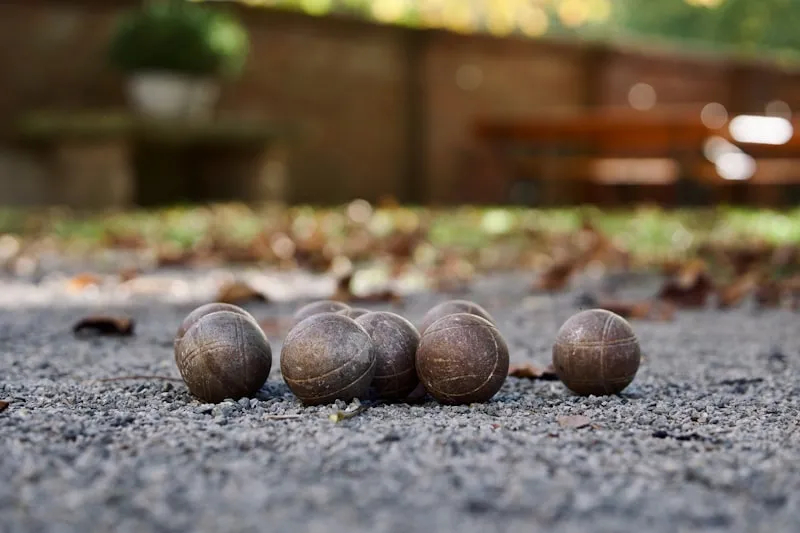
Building a Backyard Pétanque Court: From Lawn to Piste
You don't need a club to have a court. A proper pétanque piste in your garden costs surprisingly little and can be built in a weekend with basic tools.
A regulation pétanque piste is 15m long and 4m wide. In a reasonably sized garden, that fits. Even a shorter practice area of 10m gives you a usable throwing distance for pointing drills and casual games.
Here’s how to build one properly, on a budget, over a weekend.
What You’ll Need
Materials:
- Sand/gravel mix (crushed granite is ideal, 6–10mm particle size), approx. 2–3 tonnes for a 15×4m piste
- Timber or composite edging boards (at least 100mm high) for the perimeter
- Landscape fabric / weed membrane
- Corner stakes and wood screws
- Chalk line or string for layout
Tools:
- Wheelbarrow and shovel
- Hand compactor or hired vibrating plate compactor
- Spirit level (long)
- Rubber mallet
Step 1: Mark and Clear the Area
Use a chalk line or garden string to mark your rectangle. A standard 4×15m piste needs about 60 square metres of cleared ground, but 4×10m works for practice.
Strip all grass and vegetation down 15cm. Remove large stones and roots. You want a relatively flat sub-base — use a long spirit level to check, and remove high spots or fill hollows with subsoil.
Step 2: Install Edging
Cut your timber edging to length and stake it at all four corners and every 1.5m along the long sides. Timber should sit flush with final surface height or slightly above (to hold the gravel in during heavy rain). Check for level and square before fixing permanently.
Composite edging boards (from garden centres) are more resistant to rot than untreated wood and worth the slightly higher cost.
Step 3: Lay the Membrane
Unroll landscape fabric across the entire area, cutting to size and overlapping joins by at least 30cm. This suppresses weed growth without blocking drainage. Secure with ground pins at the edges.
Step 4: Add and Compact the Surface
Pour crushed granite gravel to a depth of 8–10cm. Spread evenly with a rake, keeping it roughly level. Then compact with a plate compactor (hire from any tool hire shop, around €50–80 per day) in overlapping passes.
After compaction, the surface should feel solid underfoot with minimal give. Top up any areas where the material sank more than expected, and compact again.
The ideal finished surface: firm enough that boules don’t sink more than 5–10mm on landing, loose enough that they don’t bounce excessively.
Step 5: Final Touches
Mark the throwing circle zone (a 35–50cm diameter circle at each end, 1m from the end boundary) with a paint-on line or embedded rubber circle. You’ll also want a flat area behind each end for the throwing circle itself.
Consider installing a simple canopy or shade sail if the piste faces south — afternoon sun makes pétanque genuinely uncomfortable in summer.
Cost Estimate
| Item | Approximate Cost |
|---|---|
| Crushed granite (2.5t) | €120–180 |
| Edging boards (timber) | €60–90 |
| Landscape fabric | €20–30 |
| Ground pins and fixings | €15 |
| Plate compactor hire (1 day) | €60 |
| Total | €275–375 |
That’s less than a good set of competition boules, and you’ll use the court for decades. Speaking of which, our guide to choosing your first set of boules will help you decide what to throw on your new piste.
Maintenance
Top up the surface with a thin layer of fresh gravel every 2–3 years as it compacts down. After heavy rain, rake any ruts smooth. Keep the edges trimmed so grass doesn’t creep in from the sides.
Congratulations — you now have a court. Invite people over. Throw a few boules. The garden will never feel the same again.
Read also: Choosing Your First Set of Boules: A Practical Guide · Five Pétanque Courts Worth Travelling For