Choosing Your First Set of Boules: A Practical Guide
With hundreds of boule models on the market, buying your first set can feel overwhelming. This guide cuts through the noise and helps you choose based on how you actually play.
Walk into any pétanque specialist shop and you’ll face a wall of steel spheres ranging from €20 to over €200 per set. The differences are real, but for a beginner, a €180 set of competition boules is overkill. Here’s how to think about the choice.
The Three Key Variables
Every boule is defined by three specs:
Diameter: Ranges from 70.5mm to 80mm. Smaller boules suit players with smaller hands; larger ones give a more confident grip for big hands. A common rule: measure the distance between the tip of your middle finger and the base of your palm. That’s roughly your ideal diameter in millimetres.
Weight: Ranges from 650g to 800g. Pointers (players who aim to land near the jack) tend to prefer heavier boules for stability. Shooters (players who knock opponents’ boules away) often prefer lighter boules for speed and impact energy.
Hardness: Rated from extra-soft (tendres) to extra-hard (extra-dur). Softer boules grip the terrain more, helping pointers place the ball precisely. Harder boules are faster and better for shooting. Beginners usually start with a medium hardness.
Leisure vs. Competition Boules
Leisure sets (often called “jeu de boules” sets at garden retailers) are made from mild steel or even resin. They’re fine for occasional family games but deform and rust quickly. If you’re playing at a club more than once a month, skip these entirely.
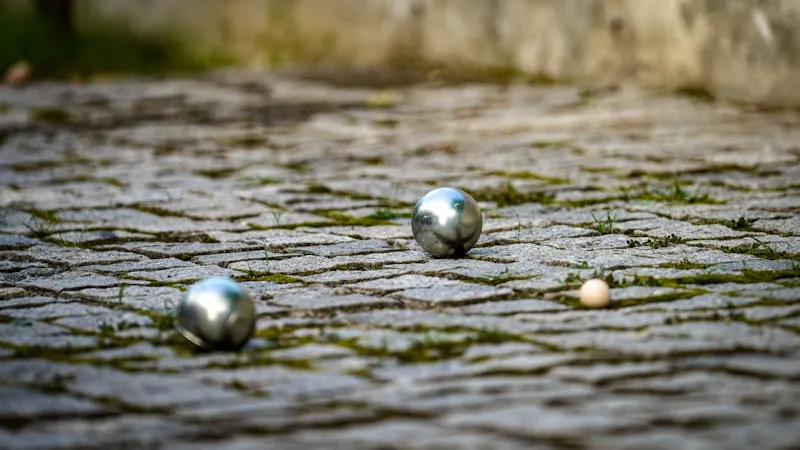
Competition boules from brands like Obut, La Franc, or Pétanque Passion are made from heat-treated stainless steel. They last for years of regular play and hold their roundness — critical for consistent performance.
Our Starter Recommendation
For a first competition-grade set, look at the Obut Match+ or La Franc Challenger line. Both sit in the €60–90 range for a set of three, offer good diameter and weight selection, and are widely available across Europe.
Avoid buying a set without trying the diameter first. Most pétanque clubs have trial boules — ask before spending.
Caring for Your Boules
Wipe boules dry after play and store them in their case. Occasionally rub them with a lightly oiled cloth to prevent rust on the striation marks. Never throw boules onto concrete or tarmac — even competition steel dents.
The engraving on your boules isn’t just decorative: it’s how you identify yours during a game. Choose a pattern you can spot from 6 metres away.
Once you have your boules, the next step is putting them to use with solid technique. Our guides to pointing techniques and mastering the tire shot will give you the fundamentals to practise from day one.
Read also: Mastering the Tire Shot: Pétanque’s Most Spectacular Move · Pointing Techniques Explained: Roulette, Demi-Portée, and Portée